There’s a sidewalk through Cassia Park on the Bench where, most afternoons, someone is walking a dog. Come up behind them on a bike and you slow down. You wait for the leash to swing to one side, look for a gap, and feel a small flash of impatience. A second later you feel like a jerk for being impatient with someone walking their dog in a park.
Nobody handed out instructions for that moment, but the setting supplied most of them: one sidewalk shared by people moving at different speeds for different reasons, with the person on wheels expected to slow down and wait. Everyone on it got a small lesson in living alongside other people, and they’ll get it again tomorrow.
Winston Churchill made a version of this argument in 1943, when Parliament was deciding how to rebuild the House of Commons after German bombs destroyed it. He wanted the new chamber kept small and oblong, with the parties facing each other across the floor, because he believed the shape of the room had shaped the way Britain argued. “We shape our buildings,” he told the House, “and afterwards our buildings shape us.”
The urbanist William H. Whyte spent years in the 1970s filming New York plazas to find out why some filled up at lunch and others sat empty. His best-known finding sounds almost too plain to need a study: people tend to sit most where there are places to sit. A plaza with nowhere to rest gets crossed and left behind. Whyte’s cameras caught people reading their surroundings all day long and doing what those surroundings made easy.
A city shapes daily habits that way, almost always without saying a word. A shaded bench tells people they can stay, and a front door facing the sidewalk makes a hello easy. On Broadway, a traffic signal far down the block nudges people into a long detour or a dash across traffic. These physical cues repeat every day, sometimes for generations.
These arrangements don’t always produce the habits anyone intended. A plaza built for gathering can push people away if it bakes in the afternoon sun. A low wall nobody planned for sitting can turn into the best seat on the block. The question worth asking about any place is what it’s teaching right now, which can be different from what the drawings promised.
There’s a limit to this, and it’s an important one. A sidewalk can’t make anyone kind. Two blocks built from the same plans can end up with very different neighbors, depending on who lives there, how long they stay, and how much they trust each other. The arrangement of a place makes some encounters easier and others harder. People decide what to do with them, and over the years those decisions become the character of a neighborhood.
One pass on a sidewalk is just a moment. Repeat it for years and it turns into something else. You start to recognize the people with the same dogs, and they start to recognize you. A park where you watched your kids learn to ride a bike stops being an ordinary park. Most of what people come to love about a place builds up this slowly, until the setting and the memories are hard to pull apart. Change the setting enough, and you can change the everyday practices those memories grew out of.
That’s why the physical side deserves more attention than it usually gets. Culture, memory and belonging get talked about as if they float somewhere above the pavement. They need somewhere to happen. Meaning needs a body.
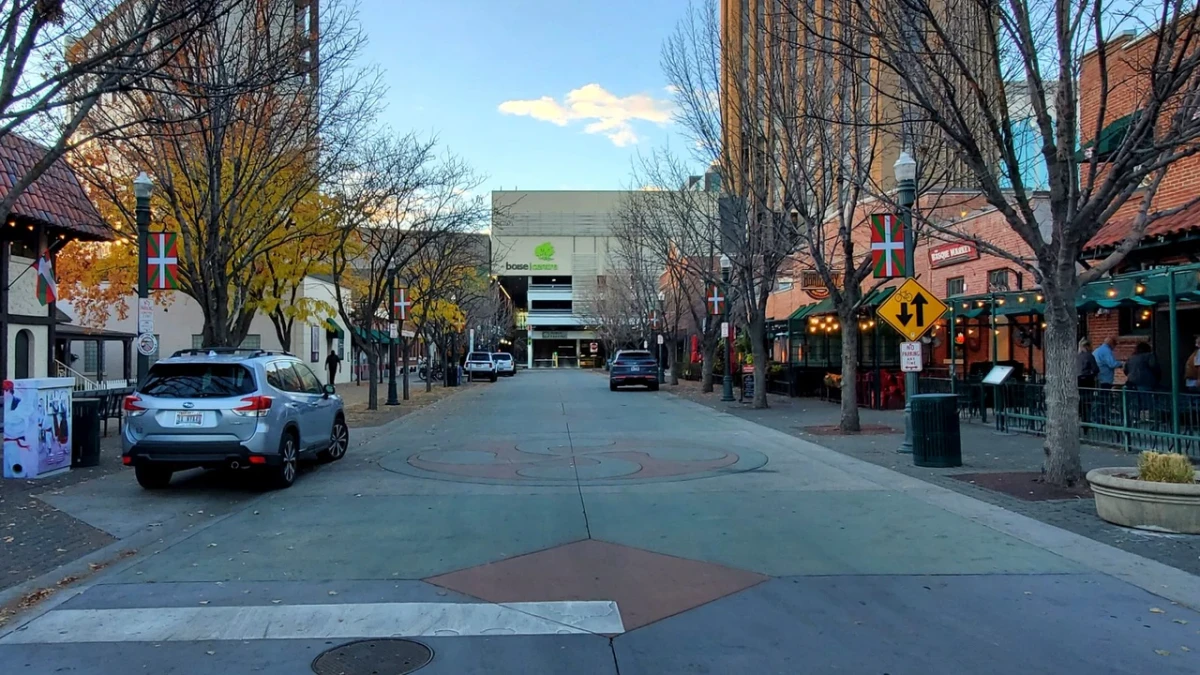
Boise has a remarkable example downtown. Starting in the 1890s, Basque immigrants who came to Idaho to herd sheep found rooms in boarding houses on and around Grove Street, where they could spend the winter speaking their own language. The Basque Center opened at 601 Grove in 1950. By the mid-1950s, nearly every building on the block was Basque-owned.
In the late 1990s, the city, the Capital City Development Corporation, the highway district, property owners and Basque families shared the cost of rebuilding the street. They took out the curbs. They paved it in red and green, the colors of the Basque flag, set a lauburu, the Basque cross, into the center, and inlaid family names in spirals along the sidewalks. The work was finished in 2000, in time for Jaialdi, the international Basque festival Boise hosts every five years.
The result is a street built to be danced on. With no curbs, the whole block can close to cars and fill with people for the San Inazio festival each summer, or for the Oinkari dancers, who have called the Basque Center home since 1960. On an ordinary afternoon it’s still a street, with lunch at the Basque Market and the fronton, the old handball court in the former Anduiza boarding house.
The boarding houses gave that culture somewhere to get through Idaho winters. A century later, the rebuilt street gave it somewhere to dance.
The rebuilding was one chapter in a long stretch of care. The block still matters because people keep doing things there: running the Basque Center and the museum, cooking, teaching the dances to kids, planning the next Jaialdi years ahead. The street gives all of that room, and each festival and dance lesson adds to what the street means to the people who grew up on it.
The Basque Block works partly because it couldn’t be anywhere else. Its paving, its names and its symbols belong to the people who use it. A lot of what gets built now could stand in any city, with the same materials and signs and a parking lot out front. Places like that can be pleasant and useful, and people still grow attached to them: the strip-mall diner where the same group meets every Tuesday, the store someone worked at for twenty years. A distinctive place gives those attachments more to hold onto, and it tells people where they are.
Boise doesn’t need every neighborhood to look like the Basque Block. A neighborhood gathering space on the Bench should feel like the Bench, and towns across the valley deserve streets and parks their residents recognize as theirs. The principles travel well, but the physical form should grow out of local history and the people who live there. Boise needs many places worth loving, each for its own reasons.
The built world is one of the main ways a city teaches people how to live together. That puts a practical question in front of anyone who shapes Boise’s public places, from the City Council and the highway district to the developer drawing a site plan. Before something gets built, someone should be able to say what it’s meant to teach: to linger, to pass through, to gather, to take care of it. After it’s built, someone should go look at what people are learning there. When the two don’t match, the place is telling the city something.
Back in Cassia Park, the sidewalk will set up the same small moment tomorrow: slow down, wait for the leash, make room.
Much of what Boise builds this decade will still be standing when today’s kids are raising their own. It will help shape how they learn to live alongside one another.
Boise should be a home with places, not just a place with homes.