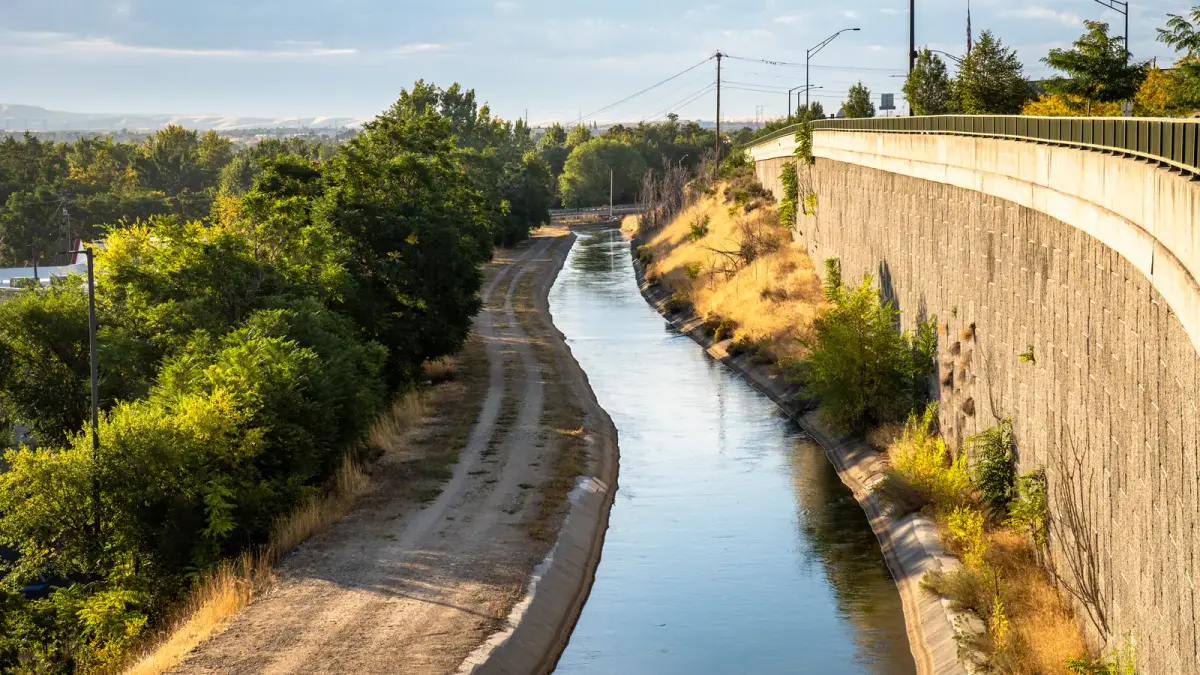
On October 9, Settlers Irrigation District shuts off its water for the year. Other irrigation systems around Boise run on their own schedules, but by fall the landscape begins a familiar transition. Water that spent the summer moving through canals and ditches stops moving.
For months, the result was everywhere: green parks, yards, street trees, gardens. The system underneath them was easier to ignore.
The shutoff does not end the work. Settlers says its crews maintain the canal system throughout the year by dredging canals, removing trees, mowing, and spraying weeds. Work affecting its ditches has to happen after irrigation season and be finished by March 15.
This is the part of the system that produces almost nothing to look at. The successful result is that spring arrives and the water can move again.
The green looks effortless because the maintenance happened before anyone needed to notice it.
Cities chase a civic version of that canopy: vibrancy, culture, a downtown people want to inhabit, a sense of place. Those are visible outcomes. The civic root system sits underneath them: durable institutions, working relationships, local knowledge, and people who keep carrying responsibility after the launch.
The mistake begins when cities try to buy the canopy directly. Events, branding, programming, and capital projects can all be valuable. But when the visible layer grows faster than the system that sustains it, the city can look successful while becoming more fragile.
One sign is the need to rebuild knowledge the city already paid to create.
In 2021, the Downtown Boise Association conducted an in-depth Treasure Valley survey that drew more than 2,700 responses. Its annual report described the results and feedback as the backbone of the organization’s new strategic plan.
Five years later, when the underlying survey materials were requested, a quick search of DBA’s shared archives turned up the Annual Report reference but not the survey materials themselves.
The visible report survived. The underlying survey did not turn up in the archive search. The result remained easy to see; the material needed to build on it had become harder to recover.
Nothing extraordinary had to fail for that to happen. Projects end, files move, and people leave. A deliverable can remain visible long after the evidence and working knowledge behind it become harder to recover.
Irrigation systems are built around an off-season. Water delivery stops, and maintenance continues so the system can function again in spring.
Many civic projects have an end date without an equivalent maintenance phase. The report is delivered. The grant closes. The committee finishes. What the work learned, who learned it, and how that capacity carries forward are much less likely to have an owner.
That is how a city pays startup costs for capacity it already paid to build once. It can maintain a crowded calendar of projects while becoming less capable underneath.
The irrigation system can reproduce the visible result because its structure expects the pause. Idaho’s lateral-water-user framework establishes an annual rhythm around the shared ditch. Water users meet, elect officers and a lateral manager for the coming season, assess the costs of maintaining the system, and carry responsibility forward before water returns.
The recurring cycle preserves the physical system and the chain of responsibility around it. The next season begins with an organization, a manager, records, obligations, and a known system of maintenance already in place.
The civic systems beneath visible projects require the same kind of continuity. A project can leave behind usable records and people who understand enough of the history to carry the next piece forward. Knowledge remains usable because someone still owns it, and relationships can continue beyond the grant or committee that first brought people together.
This changes what completion means. A report, event, public space, or planning process may produce one visible result. Completion also includes what remains usable after that result is delivered.
The civic economy rewards what can be seen. Grants fund discrete initiatives, institutions announce new programs, and ribbon cuttings provide clear public moments. Maintenance offers fewer markers. An archive stays usable, a repair happens before failure, a shared space keeps functioning. In a system organized around funding cycles and public announcements, durable maintenance often registers as the absence of failure.
That bias makes visible beginnings easier to reward than carrying capacity forward. The problem appears when an initiative consumes public goodwill, volunteer energy, and administrative relationships without replenishing them.
A serious civic effort leaves behind more capacity than it consumes.
When a project expends more trust and coordination than it replaces, the community enters the next effort with less to work with, however successful the launch appeared.
Growth widens the gap between visible expansion and the capacity underneath it. A new pathway adds something that must be inspected and maintained. A new public space adds another place with an owner, a budget, records, and eventual repairs. A new partnership creates relationships that have to survive staff changes and the end of the original project. The visible city can expand faster than its capacity to remember, maintain, and hand off what it has built.
After the headgates close, the visible results of the irrigation season remain for a while. The water is gone from the ditches, but the parks, yards, and trees it sustained do not disappear with it. Beneath that visible continuity, preparation for the next irrigation season has already begun. The system has to be maintained while the channels are dry so it is ready when water returns.
Civic life can acquire the same kind of continuity. A committee gathers and people already know how to work together. Earlier research can be found without reconstructing the project that produced it. A newcomer can enter an active effort without forcing everyone around the table to rebuild years of context.
That ease is accumulated work. It comes from records kept usable, relationships carried between projects, and responsibilities transferred before the previous steward disappears.
The work is to make sure each season of civic life strengthens what the next season will depend on.