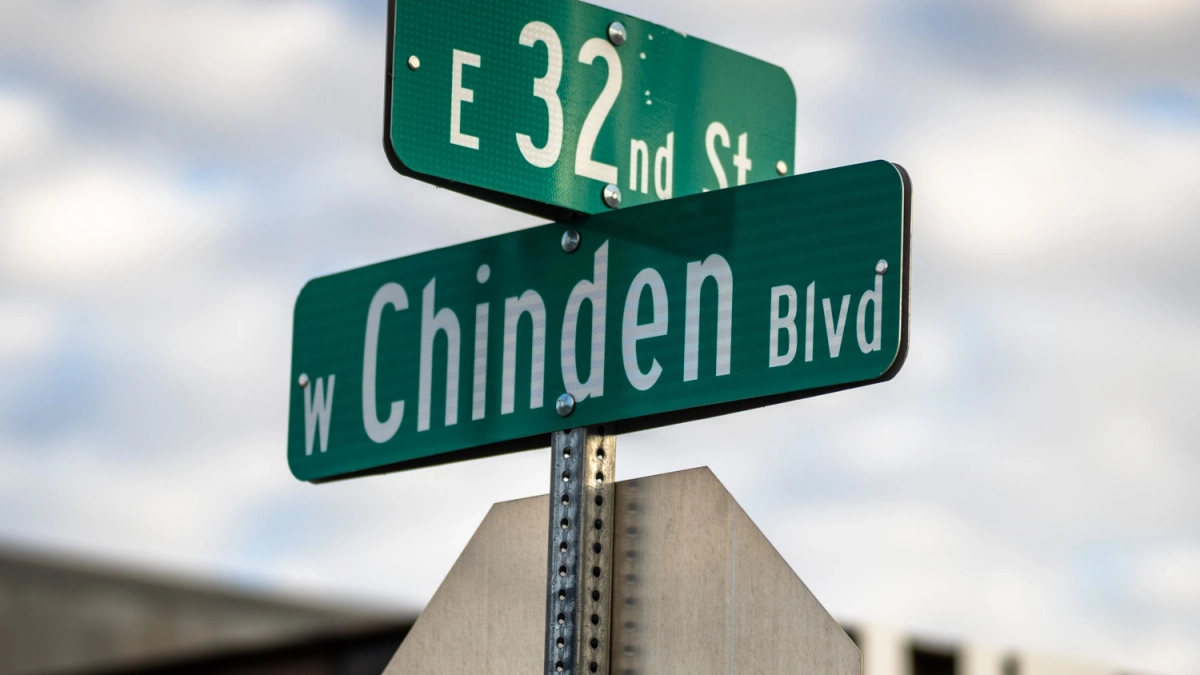
Chinden Boulevard carries commuters past strip malls, warehouses, and long lines at left-turn signals. People use the name when giving directions, read it on street signs, and type it into maps. Chinden is one of those names Boise says without hearing.
The word comes from two others: Chinese Garden.
Chinese growers once cultivated land along the Boise River in what became Garden City, raising vegetables for Boise households. The gardens gave Garden City its name. Decades later, that history was folded into the name of its main road.
The city those gardens helped feed was founded in 1863, in the middle of the Civil War.
The Civil War forced the Union to hold itself together along two lines at once. One ran north and south, through the struggle over slavery and secession. The other ran east and west, across plains and mountains that separated Washington from the Pacific states. Distance made holding the country together a physical problem as well as a political one.
Southern secession broke years of congressional deadlock over the route of a transcontinental railroad, clearing the way for the Pacific Railway Act in July 1862. The Emancipation Proclamation took effect on January 1, 1863. That March, Lincoln signed the act creating Idaho Territory. In July, streets were platted beside the newly established Fort Boise to serve the Boise Basin gold rush. In roughly a year, the government had authorized a railroad to the Pacific, emancipation had been proclaimed, and a new territory and town had appeared in the West.
Lincoln never visited Idaho, but his signature marked its political origin.
The new boundary crossed the homelands of the Shoshone, Bannock, Nez Perce, and other Indigenous nations. Within the mining districts, Confederate sympathizers gained influence, even in a territory the Union had just created.
In September 1865, the Idaho Statesman described Chinese miners passing through Boise, carrying shovels and sacks of rice.
Those miners were headed into the Boise Basin from western mining districts, drawn by the gold strikes that began in 1862. Their reception was hostile. By 1864, two Boise Basin mining districts had adopted rules excluding Chinese workers. Yet by 1865 Chinese miners were working claims there, often on ground white prospectors considered exhausted. They recovered gold from lower-grade deposits through painstaking labor, even washing boulders by hand to extract what earlier operations had left behind.
In 1869, Hung Dye and four fellow miners purchased mining property on Grimes Creek for $2,900.
The transcontinental railroad was completed that year, and some former Chinese railroad workers settled in Idaho through a different migration route.
By 1870, the federal census counted 4,274 Chinese residents among Idaho Territory's 14,999 enumerated inhabitants. The census excluded most Native Americans under its rules, but among those officially recorded, more than one in four were Chinese. Chinese workers also made up a majority of Idaho's miners.
Their livelihoods extended beyond the gold claims into stores, laundries, restaurants, and medicine. An account of Chinese miners entering the Basin in 1865 mentioned something else: a Chinese worker was already employed at a vegetable ranch on Moore's Creek.
That vegetable ranch served an economy the gold rush could not supply for itself: food. Near Idaho City, Chinese gardeners raised several harvests of greens and other vegetables in a growing season of just three months. Down in the valley, where the Boise River spread across its bottomland, other Chinese growers turned irrigated fields into productive market gardens, raising onions, strawberries, and other produce for a growing town.
Early growers walked into Boise with baskets balanced on wooden shoulder poles, selling fresh vegetables door to door. Later, wagons and Model Ts carried produce to households and stores. At Promontory Summit, the golden spike marked the completion of a railroad across the continent. A city cannot eat a railroad spike. The basket belongs beside it in the memory of the West.
Much of the cultivation around what became Garden City took place on land once reserved by the Army for growing hay for its horses. After the military relinquished Government Island, portions passed into private ownership. Thomas Davis acquired a large tract and leased fields to Chinese growers. His estate continued those arrangements after his death.
The leases came on top of decades of official hostility. In 1882, the Chinese Exclusion Act cut off immigration for Chinese laborers. In December 1885, the Idaho Statesman spoke favorably of a Boise effort to boycott businesses employing Chinese workers. The following spring, Territorial Governor Edward Stevenson issued a proclamation against plans to expel Chinese residents by force.
Federal law denied Chinese immigrants the right to naturalize, while Idaho imposed its own property barriers. Twenty-two years after Hung Dye's purchase on Grimes Creek, Idaho barred people of Asian descent born outside the United States from purchasing mining claims and associated property. The state's 1908 code imposed a broader restriction on noncitizens acquiring land. Chinese gardeners could cultivate leased fields for decades while legal restrictions stood in the way of owning them. By 1920, the census recorded just 585 Chinese residents across Idaho, down from 4,274 in 1870.
Yet the riverfront gardens continued producing long after the first mining boom. The Louie Gee Garden was one of those enterprises. The Idaho State Historical Society names Louie Do Gee and his sons William and Tong among the family members who ran it across generations. In a Boise oral history, Andy Louie recalled bunching green onions until midnight, delivering them to the wholesale house, then rising at seven the next morning to go to school.
The landscape around them was changing. In 1949, businessmen seeking to operate gambling establishments beyond Boise's restrictions helped incorporate the village of Garden City. Its name honored the Chinese farms along the river, even as a different economy was taking hold. In 1952, a contest to rename Highway 20/26 awarded Neta Danzer twenty-five dollars for joining two words into one: Chinese Garden became Chinden.
When Danzer named the road, the Louies were still farming. The Louie Gee Garden continued operating in the Boise area until 1964, twelve years after the naming contest.
The working landscape fed the city, then disappeared beneath the city it helped sustain.
At a Chinden stoplight, traffic waits for the turn arrow. Someone gives directions, using the name without a second thought.
Inside that word sits a territory created in the middle of a war, a basket carried door to door on a shoulder pole, a field a Chinese immigrant could farm for decades and never buy, and a family still farming when the name was chosen.
The city has been saying the word for decades. The work now is to hear it.
Sources & Further Reading
- U.S. Senate — Pacific Railway Act of 1862
- Idaho State Historical Society — National Issues in Idaho During the Civil War
- Idaho State Historical Society — Chinese and Chinese American People in Idaho
- U.S. Census Bureau — 1870 Census, Idaho Territory (Table II)
- Priscilla Wegars — Uncovering a Chinese Legacy (Bureau of Land Management)
- City of Boise — The Chinese Gardens
- City of Garden City — History of Garden City
- Boise Arts & History — Chinese Gardens (Louie family oral history)
- Boise Arts & History — Chinese History and Culture
- Renae J. Campbell — The Once-Bustling Basin (University of Idaho, 2023)
- Idaho Statesman — 1885 boycott (2020 retrospective)
- Library of Congress — Governor Stevenson’s 1886 Proclamation
- Garden City Visitors Bureau — Chinden Naming Contest