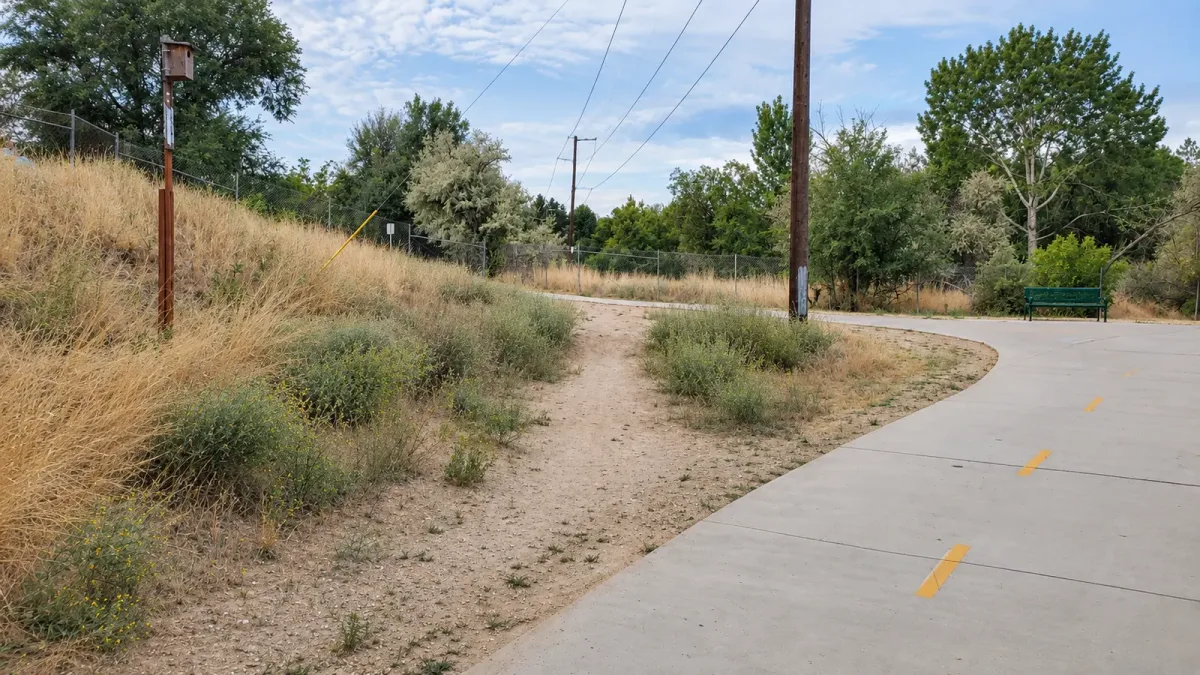
Just south of the Interstate 184 connector, beside the Greenbelt trestle bridge at Rotary Park, a paved path sweeps through a wide, deliberate curve. Inside the arc of that pavement, cut directly through the grass and gravel, runs a narrow track of bare dirt. A few yards away, on the slope leading down from the upper path, another worn line cuts straight down the embankment toward the lower paved junction, bypassing the paved switchback entirely.
The ground presents two contradictory instructions. The asphalt is wide, smooth, and unmistakably intentional. It tells the pedestrian to follow the arc, accept the extra distance, and stay on the hard surface. The dirt tracks record what people actually did when faced with that choice. Repeated use wore away the grass, compacted the soil, and established a more direct route.
These worn shortcuts are often called desire paths. They invite a quick judgment that the formal route was badly designed. The direct dirt route is visibly steeper, and the paved curve may be solving a constraint that is not obvious from the surface, including the need for a more accessible grade.
Each line gives only part of the information. The paved route records a deliberate public decision. The dirt track records repeated choices for a more direct route. When the two diverge, the disagreement deserves an explanation.
Paths are only the most obvious example. Every built environment issues a continuous stream of instructions, and the body learns to obey them without needing an explanation. A sidewalk says continue here. A curb marks the point where one surface and its use give way to another. A doorway shows where entry belongs, while a fence establishes a boundary. Painted stripes at an intersection tell a pedestrian where the street expects them to cross.
Nobody stops at each corner to deliberate over these arrangements. There is no need for a sign instructing people to walk on concrete rather than through a planting bed; the physical arrangement already supplies the command. Through repetition, the built world teaches behavior. People learn where to walk, enter, stop, and wait long before they think about who decided those locations.
At Rotary Park, people can tell which route is official before they know why it was built that way. The paved curve is smooth and deliberate; the dirt track is rough and informal. That visual difference gives the pavement authority before anyone knows the reason for its alignment.
That kind of physical authority is often useful. A bridge concentrates a crossing where beams and pilings can safely span water. Stairs break a steep rise into manageable steps. A railing marks an edge where a fall becomes dangerous, and a doorway brings a visitor to where a building is prepared to receive them. In each case, the instruction makes sense because the purpose behind it is clear. People benefit from these limits. They simplify decisions, reduce hazard, and make movement through a landscape possible.
A person using a path sees the finished route, not the decisions that produced it. The reason for a curve may still be sound, or the original reason may have disappeared years ago. Either way, the pavement remains and continues telling people where to walk.
Informal footpaths record a preference, but preference alone does not settle the question. A shortcut can be direct while leaving a hillside vulnerable to washout or creating a blind spot near faster traffic. The deliberate, official route deserves investigation before criticism.
Its authority becomes harder to justify when the purpose behind it is no longer clear. Cut diagonally across a parking lot instead of following the lanes painted for cars. Step across a landscaped planting bed to skip an indirect turn in a sidewalk. Sit on a low concrete retaining wall built as an edge rather than a bench, or pause for five minutes in an entryway designed only for circulation. Nothing explicitly forbids any of these actions. Yet doing them carries a faint, unmistakable friction: an awareness of using a place incorrectly.
People also learn to enforce these physical expectations on one another. We quickly notice when someone departs from the pattern. A person standing still in a corridor meant solely for movement draws attention because the space gives them nowhere obvious to belong. We become informal enforcers of the layout, respecting the boundaries written into the ground and expecting others to do the same.
That social pressure also complicates what observed behavior can tell us. A worn shortcut is easy to read because people have visibly ignored the official line. An untouched planting bed is more ambiguous. The formal route may work well, or leaving it may feel unsafe, muddy, forbidden, or simply conspicuous. People adapt to the choices a place gives them. Compliance therefore tells us less than it first appears to about whether the underlying arrangement still serves them.
At Rotary Park, that obedience shows up the moment a shoe leaves the pavement. Taking the dirt track across the grass visibly reads as leaving the approved route. The asphalt carries authority before anyone stops to ask whether its alignment makes sense for a person on foot.
Following the built rule becomes a problem when the rule no longer serves the purpose that justified it. A path can turn away from the direction people are clearly trying to go. A marked crossing can sit a hundred feet past the natural line between two destinations, where pedestrians routinely ignore it. An entrance can satisfy building requirements while forcing visitors through an exposed detour across a parking apron. In each case, the person on foot absorbs the friction: extra steps, lost time, exposure to traffic, and the small social unease of choosing between an inconvenient official route and an unauthorized shortcut.
Physical environments are inherited. Once a route is built, later decisions begin from it. Maintenance preserves the pavement. Signs and maps assume the same alignment. Landscaping grows around it, and people adjust their routines to what already exists. Over time, “this is where the path goes” becomes an accepted fact even after the original reason has disappeared from ordinary view. The geometry survives through choices made by people who had no part in the original design. A rule can outlive its principle. After enough time, the original reason and the accumulated habit become difficult to separate.
Repeated deviation helps reveal how people are trying to move. At Rotary Park, the worn lines establish a real movement pattern: people keep choosing a more direct line than the pavement provides. The next question is why the formal route bends away from it. If the curve serves an active constraint, that constraint belongs in whatever solution follows. If its original reason no longer applies, the repeated shortcut becomes a stronger case for changing the route.
A response can take several physical forms. If a direct connection can be made safe and accessible, the formal path could follow more closely the movement people are already making. A site that still needs a gentler accessible route might support a second, shorter foot connection such as steps or a stabilized path, while keeping the longer paved route intact. Where the worn line would damage a bank, interfere with drainage, or cross something that needs protection, the response may be to restore the shortcut and reshape the junction so the intended route is easier to understand and use.
Each option changes the ground in a different way. Formalizing the shortcut turns repeated behavior into infrastructure. Adding a second connection acknowledges two legitimate kinds of movement. Restoring the worn ground while improving the junction keeps the original route but gives people a clearer reason to follow it. In each case, the observed behavior has forced the original design decision back into view. Any redesign should begin by recovering the reason behind the existing arrangement.
Planners, builders, and public agencies in Boise should be able to explain what human purpose a physical rule accomplishes for the person using the space. When repeated behavior conflicts with a built instruction, both the rule and the deviation become evidence. Good judgment begins by recovering the reason behind the arrangement before deciding which line deserves to remain.
Beside the trestle bridge at Rotary Park, the paved arc and the worn dirt track sit beside each other. At first glance, one looks official and the other looks like people ignoring the rules. The paved route should have a defensible purpose. The dirt track shows how people are trying to move.
We have become highly disciplined at obeying the rules of places whose principles we have forgotten.
Before either line at Rotary Park is changed, the reason behind both has to be understood.