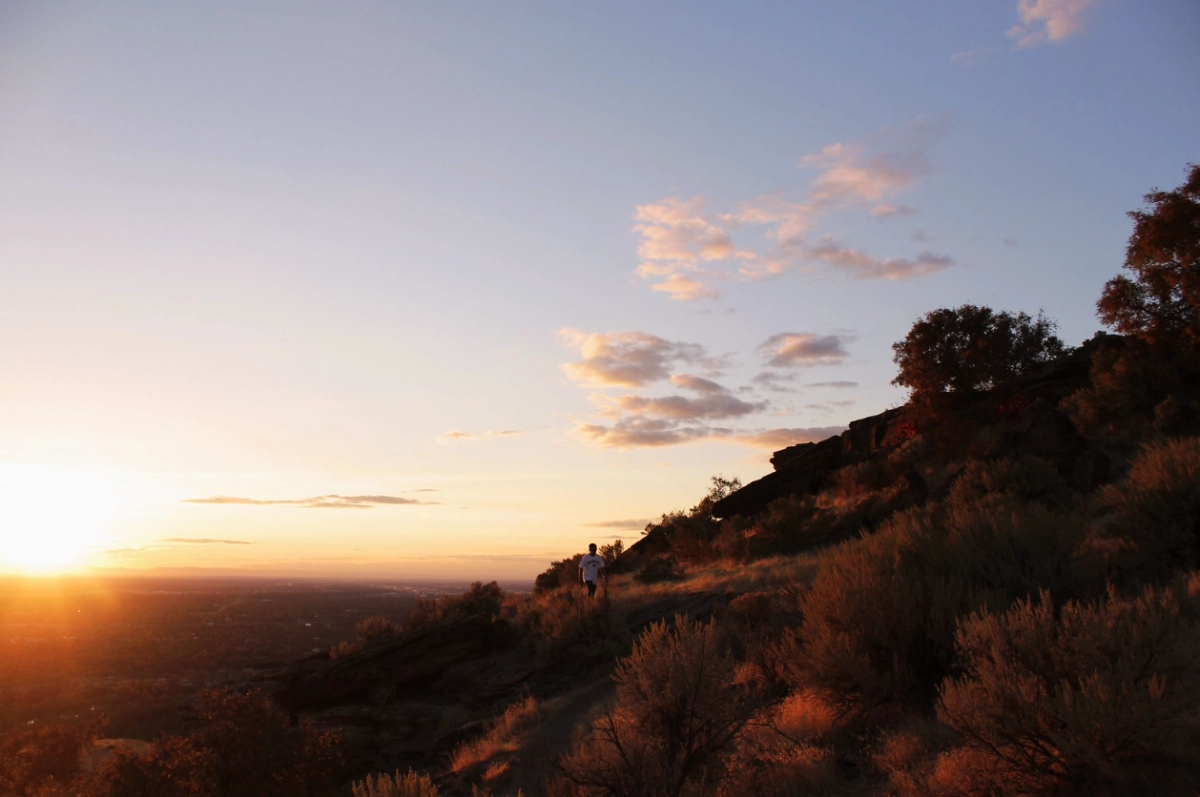
Table Rock Trail #15 climbs about eight hundred feet through sandstone, sagebrush, and dry grass. It demands steady physical exertion, the kind that quickens the pulse and tightens the calves, yet the climb remains part of ordinary Boise life. People come for an evening climb, following the switchbacks while the low sun catches the grass along the slope.
Reaching the sandstone terrace changes what can be seen. Below, neighborhoods spread beneath the foothills, and the river cuts a line across the valley floor.
The more significant discovery faces the other direction. Looking past the edge of the plateau, the higher contours of the Boise Front rise thousands of feet above the bench. Table Rock is an achieved height, an intermediate ledge. The climb took real effort, and it ends with the mountains still standing well above it.
Table Rock carried meaning long before modern Boise spread beneath it. The Idaho State Historical Society describes the mesa and surrounding area as sacred to several Native American tribes. Any newer civic meaning attached to the place sits inside that older history.
Ordinary language already treats growth as upward movement.
The idioms of everyday speech preserve this connection. People speak of rising to the occasion, holding someone to a higher standard, falling short of an expectation, or lifting another person up. Each expression treats personal development as an ascent.
Inside that language sits an assumption about human potential: that someone can become capable of meeting demands that once exceeded them. This vertical movement measures progress entirely against where a person began, the way a walker measures height from the valley floor rather than rank over a neighbor. It means developing the footing, stamina, and restraint to handle demands that would have broken earlier habits.
Communities develop along the same line. A city can remain locked in immediate reactions, treating every local dispute as an isolated emergency. It can also cultivate the collective strength to look past the current election cycle and take responsibility for what outlasts it. At both scales, the direction is identical. Rising begins with the recognition that greater capability is possible, and that acquiring it changes what a person or a town is equipped to answer for.
A novice looks after their own tools; an experienced builder is responsible for the safety of the entire scaffold. As a person gains skill, resources, or authority, the field of consequence expands around them. Growth is a steady increase in what an adult is expected to answer for: more people, more complex tasks, and a longer horizon of time.
That development remains incomplete when it terminates in private advantage. An effort rises when it creates room for others to take on real work, test their own judgment, and share in the outcome.
Consider a resident helping with a proposed neighborhood path. The first task might be to photograph a broken connection and mark it on a map. Working with someone experienced, the resident learns to distinguish a design problem from a question of ownership or permission, and to explain why the shortest route may be difficult to build. They can then take responsibility for presenting those findings to neighbors. On the next project, they can help a new volunteer make the same distinctions. The work has given them a task they can carry independently and something useful to teach.
A city follows the same trajectory. A frontier settlement scrambles for roads, clean water, and basic survival. A mature city, inherited from generations of steady effort, has the margin to look further ahead: keeping the sandstone ridges of the Foothills open to the public, protecting the cold gravel and shade along the river, and building neighborhoods designed to outlast their developers.
Idaho runs on an enormous reservoir of civic labor. Across the valley, residents coach youth teams, serve on irrigation and cemetery boards, plant bitterbrush in the foothills, organize neighborhood associations, and fund school programs simply because a concrete need appeared.
The primary difficulty today is how thoroughly that landscape is divided. A resident moves through a continuous environment of streets, parks, and waterways, yet that single territory is split among dozens of separate authorities. Ada County Highway District maintains the local roads. City departments manage parks; irrigation companies operate canals; and distinct nonprofit boards pursue their own philanthropic goals. Each operates inside its own legal boundary, budget cycle, and technical scope. People experience one Boise. Institutions administer many Boises.
When public life is fractured this way, the most important work often falls between the boundaries. A pedestrian route breaks down at a property line, or a badly needed public space stalls because no single entity is responsible for the whole result. At this scale, rising means gaining enough altitude to see how these separate pieces fit together. The work is to bridge those gaps: linking a path across an irrigation bank, helping separate organizations pull in the same direction, and turning isolated goodwill into lasting public ground.
In public disputes, rising means looking past polarized labels long enough to see what each side values while staying grounded in the physical facts. Many civic arguments pit legitimate goods against each other. A debate over a Foothills path quickly divides into a contest between public access and environmental protection. One voice defends recreation; another protects fragile soil and wildlife habitat. When these positions harden into political labels, public debate stalls.
Rising above the labels brings the larger civic principle into view. The task is to find a design capable of preserving the legitimate good each group is trying to protect. A well-constructed trail channels foot traffic onto durable tread, allowing the public to complete the journey while protecting the surrounding hillside from erosion. Not every civic dilemma resolves this cleanly, but the aim remains consistent: unity without demanding sameness. A healthy community allows people to value the same landscape for different reasons, provided the physical arrangement can carry both goods.
This practice of holding distinct goods together belongs to Idaho’s constitutional inheritance. Idaho’s Declaration of Rights places liberty, property, happiness, and safety in the same opening provision. Rising to meet a modern dispute draws directly on that tradition. It looks past temporary factional lines to discover a higher-order design, then returns to the ground to build it.
Table Rock sits between two landscapes. Below, the valley floor stretches west, carrying the neighborhoods, the canal corridors, and the line of the river into the open plain. Above, the timbered ridges of the Boise Front rise thousands of feet higher into the mountains.
The plateau is an achievable height. Reaching it requires neither specialized equipment nor extraordinary endurance, proving that moving out of the immediate valley is possible through steady physical effort. Standing on the stone demonstrates an earned elevation, while the peaks towering behind it keep that accomplishment in perspective. A real ascent expands the horizon without concluding the journey.
Vertical ascent carries an ancient resonance. In the story of Jacob’s ladder, the foot of the ladder is planted firmly on the earth while its top reaches toward heaven, connecting common ground to a higher order. Climbing leaves immediate noise behind and reveals a wider terrain.
Yet the ascent remains incomplete if it ends on the terrace. A vantage point that terminates in contemplation becomes an escape from the world. A community cannot live on a scenic overlook. Insight that never touches the valley floor remains an abstraction, powerless to repair a damaged bank, resolve a contested boundary, or build a lasting neighborhood. Whatever clarity is gained at height must walk back down the switchbacks, carrying that wider perspective into the daily negotiations of the city below.
This disciplined return gives the word Rising its civic meaning. It names an active direction of travel rather than a claim of arrival. The energy is already here. Rising names the effort to connect the work people are already doing, accept wider responsibility, and bring better work back to the streets and neighborhoods we share.
Rising means gaining enough height to see what belongs together, then returning to the ground and building accordingly.