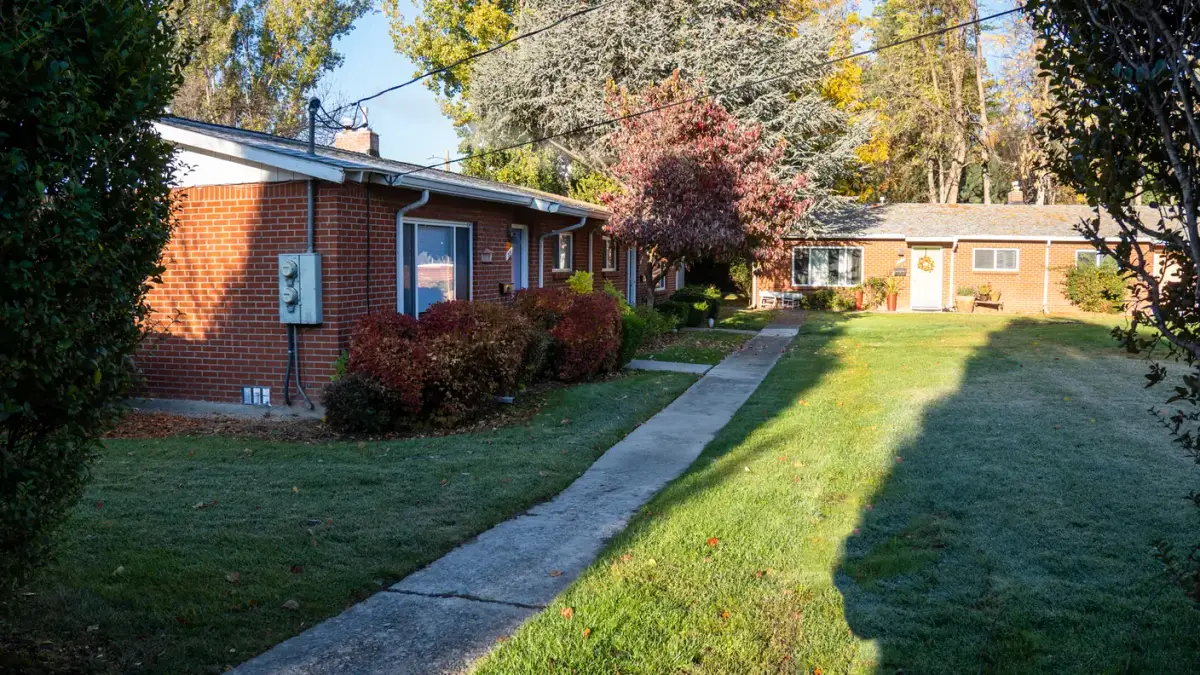
At 1318 North 11th Street, in Boise’s North End, a building listed as dating from 1912 now contains four apartments. Two are on the main floor and two are downstairs. According to a recent property listing, each has its own kitchen and bathroom.
In the North End and West End, small apartment houses, duplexes, and rows of townhomes still sit among the detached houses. They went up in different decades, and on streets of old trees and mismatched houses, nobody looks twice at them.
A 2025 city design brief notes that few homes like these have been built in recent decades.
Part of the explanation was written into the city’s rules.
Before Boise rewrote its zoning code in 2023, its largest residential zoning district was R-1C. According to a 2023 BoiseDev analysis, that designation covered about 58 percent of the city’s residentially zoned land. County records put the four-apartment building on North 11th Street in R-1C, too.
The old code allowed duplexes subject to certain standards. A building with three to six apartments required a conditional-use permit. The city reviewed each proposal separately and could say no. Other multifamily categories were left blank in the R-1C column of the city’s table, and a blank meant no.
The district also capped density at eight homes per acre, with some exceptions. The detached house was by far the easiest choice under the rules.
After World War II, families wanted houses and yards of their own, and new subdivisions helped meet an enormous housing shortage. Over the following decades, minimum lot sizes, parking requirements, lending practices and zoning maps made that kind of house far easier to build than the smaller homes already found in established neighborhoods.
There were uglier tools, too. Researchers at the College of Idaho found racially restrictive property covenants across more than 50 Ada County subdivisions. Those deeds barred people from living in certain neighborhoods because of their race. These restrictions were written into private deeds rather than the city’s zoning code.
Take a couple who have lived on one Boise block for thirty years.
They bought their house when the children were small. Now the yard takes more work than it used to, and they’d be happy with fewer rooms. They know the neighbors by name. Maybe their daughter lives a few streets over. They’d like to keep running into the same people at the mailbox or on the sidewalk, without having to arrange a visit.
But what if the only homes nearby are houses just as large as theirs?
They could stay and maintain more house than they need, or look for something smaller much farther away. An apartment or duplex down the street, if they could afford it, would let them move without leaving the neighborhood.
The same goes for a grown son who wants his own place near his aging parents, or a single parent who needs a rental close to the kids’ school.
A small apartment on a familiar block lets someone stay within walking distance of people they already know. The neighbor who lends a ladder is still nearby, and a conversation on the sidewalk can still happen by chance.
A front door facing the sidewalk gives neighbors more chances to say hello. Inside, a well-built floor between the upstairs and downstairs apartments means nobody has to tiptoe to the kitchen at night.
In 2023, Boise started to change the rules. The City Council adopted a new zoning code that took effect that December, and it has been amended since.
Under the current rules, R-1C allows more forms of small housing. Triplexes and fourplexes, for example, can qualify through housing incentives, although they’re still subject to conditions. The base density ceiling rose from eight to 12.4 homes per acre, with exemptions for duplexes, accessory dwellings, and qualifying incentive projects.
Boise also dropped the old owner-occupancy rule for backyard cottages, allowing property owners to rent them out even if they live elsewhere.
New neighborhoods should have that variety, too. Streets at the edge of town could start with duplexes and cottages already mixed among the houses. On established blocks, the design of new homes should take its cues from what is already there.
A small builder still needs financing, and each site brings questions about utilities, parking, trees and the privacy of nearby residents. Clear design standards and predictable permit reviews would help.
In a February 2025 review of the first year under the new code, the city counted 63 approved homes in neighborhood-scale projects containing three to twelve units, about six percent of the 1,016 approved units it examined. Another 130 approvals were for accessory dwellings. Large apartment projects of fifty homes or more accounted for 560 units.
In April 2026, Boise’s Neighborhood Housing Design Lab showcased designs for fitting smaller homes into established neighborhoods. Boise already offers free, pre-approved plans for backyard cottages. It could do the same for duplexes and fourplexes: a handful of good designs and a clear list of which lots qualify, so a homeowner or local builder starts from a plan instead of a blank page.
On North 11th Street, four apartments share a building among the detached houses. You could pass it without knowing how many homes it holds.
A couple who have lived on a block like that for thirty years may one day want a smaller home. There ought to be one within walking distance.